Showing posts with label Great Kiva. Show all posts

Monday, September 15, 2008

Casa Rinconda Trail at Chaco Canyon

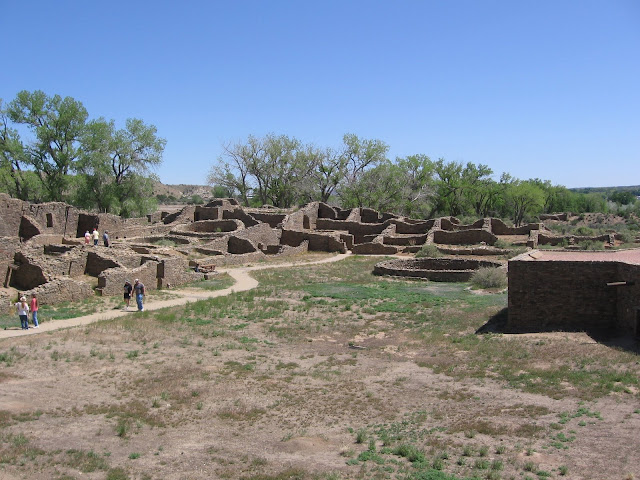
The Casa Rinconda Trail is a 0.5 mile loop that visits three small village sites plus a Giant Kiva in Chaco Canyon National Historic Park in northwest New Mexico.

The trail head is toward the west end of the loop road on the south side of Chaco Wash and is the last major stop around the loop.

In contrast to the multi storied engineered Great Houses that dominate the canyon, these village sites were mostly one or sometimes two stories, with thinner walls, and seem to have been remodeled and added onto as needed.

These sites were in use at the same time as the Great Houses and were places where more people actually lived.
These small village sites began as pithouses, circular depressions in the earth, and expanded with a row of room blocks for storage. Eventually the circular pithouses were lined with stone and became the ceremonial kivas.
Looking across the village site to the north Pueblo Bonito, the largest Great House in Chaco Canyon, is visible. Behind Pueblo Bonito the extent of the 30,000 tons of sandstone that crashed on the back of the site in 1941 is visible.

From this angle the crashed rubble pile looks more massive than the building site is. At the back of the Casa Rinconda Trail, stop 10, the back country trail to the Tsin Klitsin site connects.

Casa Rinconda is the largest excavated Great Kiva in Chaco Canyon and one of the largest in the Chaco Culture. It is aligned on a north and south axis. The Kiva has many of the typical features such as a bench around the perimeter, niches set into the walls, a fire pit, and pits to support the large timbers that held up the roof.
This Great Kiva has an unusual feature of a lower entryway placed beneath the steps of the northern entryway, and looks like a stone lined trench. On a previous visit here visitors were allowed to enter and walk around inside, but the way is blocked off now.

It seemed a little odd to me that such a large kiva was associated with small villages. There were many more residences here than we see but the other large kivas we see are associated with the Great Houses. Maybe it is something like a smaller college town now that can still have a giant football stadium.


Tuesday, September 9, 2008

Pueblo Bonito Trail at Chaco Canyon

The Pueblo Bonito Trail is a 0.6 mile loop that visits the heart of the Chaco Canyon Culture that flourished between 850 AD to about 1150 in a remote canyon in northwest New Mexico.


The trail starts about four miles west of the Visitor Center along the canyon loop road. The Chetro Ketl Trail starts at the same point and branches the other way.

The large ruin site is D shaped with the flat wall facing out toward the center of the canyon, the rounded part facing the sandstone cliffs. This orientation is the opposite from some of the other sites along the canyon wall.

The trail passes by the east corner, the circles counter clockwise to the back, then cuts through to the plaza area. At the east corner is a good view of the fine stonework of the core and veneer of the thick walls.

In 1941, following a year of heavy rains, 30,000 tons of rock broke loose from the sandstone cliffs called Threatening Rock, and destroyed about 30 rooms at the back of the site.

There is evidence that the Chaco builders recognized the danger back in 850 AD when they selected the site, and built some terrace structures to shore up the detached rock segment that had a wide crack. Prayer sticks were also installed just in case.

From an overlook point in the back there is a good view of the geometric layout and the plaza area. Construction is thought to have begun here around 850 AD and continued until about 1100 AD.

It is estimated that only 50 to 100 people actually lived here and the main use was for ceremonies, trading, hosting visitors, and other special events.

Passing through the back wall into the plaza area, the trail leads to the west corner with a view back across the entire site. There is a north and south low wall here that divides the plaza area into an east and west half.
At the center of the plaza is the Great Kiva. This is on the east side of the dividing wall. This is thought to be a structure that could accommodate hundreds for community ceremonies. There would have been a roof over it and a plaza level entry way of stairs down into the subterranean seating area.

From the plaza, a trail route for the mobile passes through a series of interior rooms. There are 11 narrow doorways to go through that are 41-46 inches high. My backpack was bumping the lintels on most of them. Besides the stonework, the method of construction of the ceilings could be viewed.

A layer of large logs supported a layer of smaller ones and layers of more plant material and mud mortar were placed on top. There are a few fragments of wall plaster in some places and the unusual feature of corner doorways.


Sunday, September 7, 2008

Chetro Ketl Trail at Chaco Canyon

The Chetro Ketl and Pueblo Bonito Trails start at the same place and branch away from each other. These are the two largest complexes at Chaco Canyon in northwest New Mexico are nearly side by side.

These two sites are about four miles west of the visitor center along the canyon loop road. The Chetro Ketl Trail is about 0.5 miles.

Chetro Ketl was built starting about 1000 AD and over the next 100 years grew to about 500 rooms covering 3 acres. The site is D shaped and has a large plaza area in front of the room blocks. The trail cuts through the plaza from west to east before circling around the back.

The rooms along the front wall show some evidence that there were influences from Toltec Mexico here. In the front there were originally colonnade structures, square masonry columns along the wall of a long narrow room. Later renovation appears to have filled in between the columns and then subdivided the long narrow room.

The trail continues in front of the long wall of room blocks and circles around to the subterranean Great Kiva. From the angle looking back at the main room blocks, the entry way to the kiva is visible and some of the internal features including the well like foundations for the columns that supported the roof.

Four sandstone disks were found in the foundation pit and oddly, a bag of powdered turquoise was found at the bottom.
On the east side of the plaza is a series of circular structures. One of them had an odd figure eight shape. The other circular structures have some of the features of small kivas but the figure eight appears to be featureless inside.
Passing along the back wall the stone work can be examined closely. These walls were originally covered with a plaster that has worn away.

There is evidence that along the back wall there were once small balconies on the second and third stories. The cross sections of the walls shows the somewhat jumbled core with the smooth outer veneer placement of stones.
The last part of the trail passes a structure called the Talus Unit for its location near a pile of fallen rock debris. This group of rooms is separate from the main room blocks but is thought to have been part of the system.
This area is only a few steps away from the main structures, but perhaps it had a slightly different function. Behind the Talus Unit is a stairway that connected to the roads and structures on top of the sandstone cliffs.


Tuesday, June 3, 2008

Salmon Ruins Trail

Salmon Ruins is on the site of the Salmon family homestead in Bloomfield in northwest New Mexico, and the site is named for them. Besides the Pueblo Ruins there are also the late 1800s ruins of the Salmon Homestead available for public viewing.The site was a Chaco Canyon outlying community on the north bank of the San Juan River. It was built in the late 1000s and had 150 rooms on a ground floor with more on second and third stories.
It is thought that this site was abandoned by the Chaco Canyon influenced Pueblo People and re-occupied by Mesa Verde influenced people. The evidence for this is some of the original rectangular rooms were modified into circular rooms.

The quarry for the sandstone blocks used here is thought to be about three miles north, while the timbers came from much further away.
The Tower Kiva was an important structure in Pueblo life at Salmon ruins. There is evidence of a fire that destroyed this large kiva during the second occupation, causing loss of life. It is also thought that there was a second ritual burning as part of a final abandonment.
There is also a great kiva located out in the central plaza that has many of the usual features such as a circular bench. a fire pit and ventilation shafts. This kiva has a chamber on the north thought to be used for storage.

Saturday, May 31, 2008

The Great Kiva at Aztec Ruins

The final stop on the Aztec Ruins Trail is the Great Kiva. It is situated in the center of the plaza of the west ruin, a huge site with at least 400 rooms.

The Great Kiva at Aztec Ruins in northwest New Mexico is the only reconstructed Great Kiva of the dozens in the southwest. It was reconstructed in 1934 based on the remnants of the original building.

Entering the Great Kiva is something like entering a church. The kivas were thought to be used for religious purposes and were constructed down into the earth, entering the realm of the spirits. "Show respect" the interpretive signs remind visitors.

The inside is nicely plastered and painted in red and white. It is easily forgotten that most walls at these ruin sites were plastered and decorated. Now, we mostly just see the raw stone work, weathered for 700 years.

Around the perimeter are 15 rooms with ladders and small doors. These small rooms had doors out onto the plaza also. It is not known what these rooms were for. The large beams in the roof would have had to been brought from many miles away as the immediate environment around Aztec Ruins doesn't support large trees.
Four large columns support the 95 ton roof. The foundation for the columns were four limestone disks, which had to have been carried from at least 40 miles away. The feeling I got from the interior was like it was a nice reception area for an upscale resort.

From the exterior you can gaze in through the door of one of the 15 surrounding small rooms. The interpretive literature at these southwestern ruins sites doesn't mention where visitors and travelers stayed. That's how the Great Kiva's outer rooms struck me, as a nice place for visitors.


Tuesday, May 27, 2008

Aztec Ruins Trail

Aztec Ruins National Monument is an large Ancestral Pueblo site near the Animas River in northwest New Mexico. It is misnamed, as is the town of Aztec, NM as the Aztecs of central Mexico had nothing to do with this area.

The West Ruins has been excavated and is a massive structure of about 400 rooms with three stories, with very thick walls. There is an equally large East Ruins that remains unexcavated and is not open to the public except on special tours. The trail that winds around the West Ruins is short, about 700 yards, but there is a lot to see.
It is thought that Aztec Ruins was originally occupied and influenced by the Chaco Canyon culture. Chaco Canyon is a major site about 55 miles to the south and was the main center of Pueblo culture until about 1100 AD. The center of Pueblo Culture shifted north to Mesa Verde after 1100 and Aztec Ruins shows these influences also. The inner walls here show the alternate sized bands of stones of the Chaco style and the outer walls show the more even sizes of Mesa Verde style.

There are a few places at Aztec where doorways are placed at corners, a rare feature and unique to the Chaco style. This was risky as it weakened the walls. One of the reasons that these structures eventually failed is that walls were not bonded well. Many of these walls were without solid foundations. As the walls settled, they tended to separate at the weak corners.

A structure just outside the main walls is called the Hubbard Tri-wall site. The space between the three concentric walls was divided into eight rooms in the inner circle and fourteen in the outer, with a central kiva. The site has been filled in with dirt to keep it from collapsing. Tri-wall sites are rare, but there is another one to see in Chaco Canyon at Pueblo del Arroyo site.

The environment at Aztec is dry and nearly desert, with only sparse Pinon Pine and Juniper trees growing. There was abundant water however from the Animas River, flowing down from the San Juan Mountains in southwest Colorado. This site was abandoned in the late 1200s as were all the Ancestral Pueblo sites in the Four Corners area.