Showing posts with label Pueblo Grande. Show all posts

Saturday, December 24, 2011

Hohokam and Pueblo Grande Exhibit

Beginning in the winter season of 2011 to October 2012 the Anasazi Heritage Center near Dolores, Colorado is hosting the Pieces of the Puzzle – Hohokam Exhibit displaying new ideas on the Hohokam Culture.

The Hohokam culture is known for the extensive irrigation works on the Salt River in the Phoenix, Arizona area. An easy to visit Hohokam site is the Pueblo Grande site in Phoenix, AZ located at 4619 East Washington Street, near the northeast side of the Sky Harbor Airport. Part of the Dolores, CO display includes artistic renditions of Hohokam life including the Pueblo Grande site.

The elevated overview of Pueblo Grande site isn’t actually available at the site. The trail travels along the sides of the platform mound and also climbs up on top. From the top of the mound there is an overview of the rest of the site.
The Pueblo Grande platform mound is one of more than 50 known in Arizona with nearly half of them in the Salt River Valley. The mounds are located at regular intervals of approximately three miles along the major irrigation canals.

At the Pueblo Grande site there are replicas of residential structures. The artist rendition appears to depict the circular pit house style that prevailed from 450 to 950 AD. On the Pueblo Grande site, one of the residences is open for visitors to enter and inspect the inside details. The frame is described as mesquite or cottonwood trees. Branches or Saguaro Cactus ribs are lashed to the frames.

There are replica artifacts arranged inside. One of the women in the artist rendition appears to be working on pottery and using the paddle and anvil technique that is described in the Dolores Exhibition. There a small pottery dog next to her. Some examples of these pottery dogs are on display in Dolores also.

Sunken ballcourts similar to ballcourts in Mexico were built at some of the Hohokam large sites between 700 AD and 1100 AD. The ballcourt at the Pueblo Grande site is one of the few of the 200 southwestern United States ballcourts discovered that have been excavated.

At the Pueblo Grande site the interpretive information says that use of ballcourts was discontinued sometime after 1200 AD. One of the main points of the Dolores Pieces of the Puzzle Exhibit was to discuss possible reasons why the whole Hohokam Culture gradually declined and disappeared.


The desert scene depicts Hohokam petroglyphs near Tucson, AZ.

Outside the Pueblo Grande Museum there are some example petroglyphs that have been relocated there. One of the museum images is clearly a mountain sheep. The other image is somewhat vague but looks like it could be a mountain lion.

Another of the artist renditions shows a scene at the headworks of the irrigation system. One of the puzzle pieces of the Dolores Exhibit shows how population shifted from the central core sites like Pueblo Grande to sites more at the distant ends of the irrigation system. This was a problem as these headworks still needed operation and maintenance.

18407_$5 Shipping on Orders of $99 or More!

Wednesday, September 14, 2011

Pueblo Grande Hohokam Ruins in Phoenix

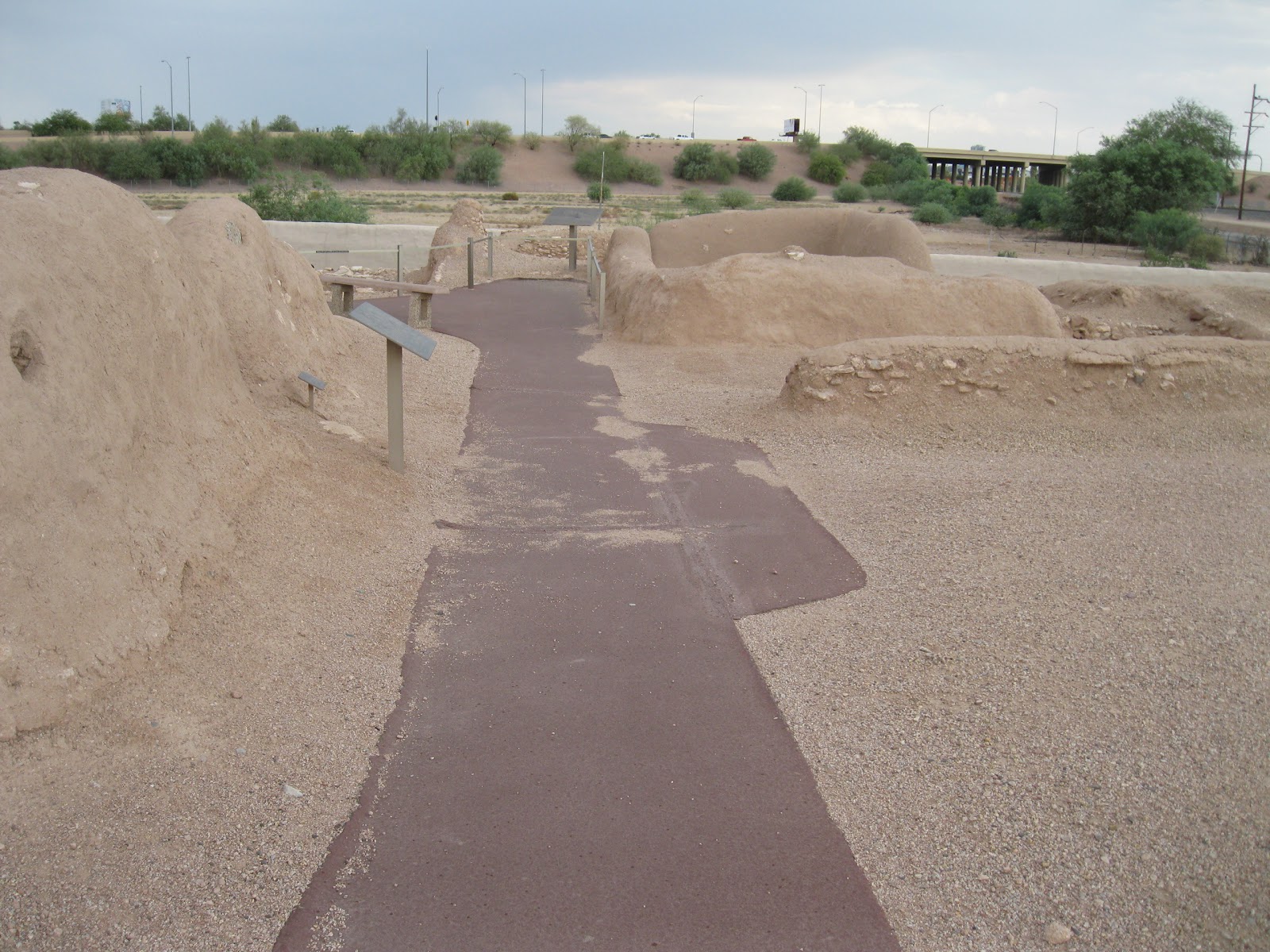
Pueblo Grande is a large Hohokam ruins site located in the central area of Phoenix, Arizona. There is a one third mile trail that tours a platform mound, the most significant structure. The address for this urban site is 4619 East Washington Street. It is near the northeast side of the Sky Harbor Airport. In 2011 there is a $6 admission charge.
The Hohokam are famous for their extensive network of canals. The Pueblo Grande site is at the head works of part of this system. Water was diverted from the Salt River into an irrigation system feeding thousands of acres of farming fields

The paved trail leads up on top of the sandy beige colored structure where there are views of some of the excavated rooms. This adobe type construction site contrasts with extensive stonework ruins sites in the other areas of the Four Corners region. The platform mound is thought to be a ceremonial and administrative center rather than a place where residents lived.

There are interpretive signs along the trail describing some of the history of the site and comments on what was found here and offering some possible interpretations. An adobe wall three feet thick and eight feet high surrounds the platform mound. The wet mud and caliche material was applied in courses rather than as mud bricks. In the 1300s the platform mound was nearly 25 feet high.

The overall site once extended to the north for more than a mile. There were many small residential compounds and other structures. The platform mound may have started as two separate mounds that eventually grew together. The main period of use was from 1150 to 1450 AD.

On the north side of the platform mound, there are some replica adobe compounds from 1300 AD and pithouse structures from 950 AD. A wood frame was made from mesquite or cottonwood trees and the spaces filled with branches or saguaro cactus ribs.

An Adobe mud plaster covered the wooden frame. One of these replicates can be entered and there are replicate artifacts arranged for easy viewing. These replicate structures are taller than the originals with large doors for our convenience.

Near the end of the trail is a ball court. The court is 82 feet long and 38 feet wide. The interpretive information says that this is one of the few that have been excavated of the 200 or so that have been located in the southwest.

This court is thought to have been used between 750 and 1200 AD. It seems odd that the ball court use ended in 1200 while the overall site continued to be used until 1450. In the vicinity of the ball court, there are some example Hohokam gardens and some of the desert plants like Ocotillo, Screwbean Mesquite, and Chainfruit Cholla are identified.

There are interpretive museum displays at the Pueblo Grande site. One that I found interesting was the large map of the 1000 miles of Hohokam canals and the irrigation system. The map shows many other related ruins sites in the area along the Salt River. Outside the museum the American Society of Civil Engineers has erected a plaque commemorating the canal system as an Historic Civil Public Works Project. There is also a theater with a 10 minute video of Pueblo Grande and the Hohokam.

I visited on a 95 F early September afternoon. My tour took about 1.5 hours and there were only a few others here during my visit. The ruins viewing was very calm in the midst of busy nearby freeways and airport.


528669_Russell Womens Fleece Hoodie Banner